Using Large Language Models for Recommendations
Large Language Models (LLMs) are versatile tools that are part of many scientific and industrial applications. One of their biggest advantages is that they distilled vast amounts of knowledge from diverse sources, enabling them to make connections and draw conclusions from a completely different perspective compared to traditional Bayesian Optimization methods.
In this example, we demonstrate the usage of the
LLMRecommender class for making
recommendations based on large language models.
Imports
import json
from unittest.mock import patch
import pandas as pd
from baybe import Campaign, active_settings
from baybe.objectives import SingleTargetObjective
from baybe.parameters import NumericalDiscreteParameter, SubstanceParameter
from baybe.recommenders import (
    LLMAlternatingRecommender,
    LLMRecommender,
    LLMTwoPhaseRecommender,
    RandomRecommender,
)
from baybe.searchspace import SearchSpace
from baybe.simulation import simulate_scenarios
from baybe.targets import NumericalTarget
Settings
N_DOE_ITERATIONS = 3
N_MC_ITERATIONS = 2
BATCH_SIZE = 2
The Scenario
LLMs shine where they can leverage the knowledge and information they have acquired during their training processes. They are thus in particular well-suited for tasks that benefit from knowledge that is hard to express in traditional rule-based systems or via explicit constraints. We therefore demonstrate their usage in a chemical reaction optimization scenario.
We read the information about the conducted experiments from a CSV file. This data set was obtained from Shields, B.J., Stevens et al. Nature 590, 89–96 (2021) and contains yield measurements for a direct C-H arylation reaction. The study systematically varies five reaction conditions: the solvent, the base, and the phosphine ligand (each identified by name and molecular structure), as well as the reaction temperature (in °C) and the substrate concentration (in mol/L). Together, these span 1728 unique experimental configurations, all of which have been measured and serve as the ground truth for the simulation below. Depending on your system and settings, you might need to slightly adjust the following paths.
try:
    lookup = pd.read_csv("benchmarks/data/direct_arylation/data.csv")
except FileNotFoundError as e:
    lookup = pd.read_csv("../../../benchmarks/data/direct_arylation/data.csv")
    print(e)
[Errno 2] No such file or directory: 'benchmarks/data/direct_arylation/data.csv'
Using Natural Language While Setting Up the Components
BayBE’s LLMRecommender allows us to
describe various aspects of the problem we want to solve in natural language. We can
provide descriptions and metadata for the several BayBE objects and also supply
an explicit experiment description that the LLM uses to make informed recommendations.
EXPERIMENT_DESCRIPTION = (
    "Optimization of a direct C-H arylation reaction. Each experiment selects a "
    "solvent, a base, and a ligand (given by their names) together with a reaction "
    "temperature and a substrate concentration."
)
To leverage natural language for the parameters, we provide descriptive metadata, including a unit, a description, and additional context that the LLM can incorporate into its reasoning.
solvent = SubstanceParameter(
    "Solvent",
    data=dict(zip(lookup["Solvent"], lookup["Solvent_SMILES"])),
    encoding="MORDRED",
    metadata={
        "description": "Organic solvent used in the reaction",
        "role": "Controls polarity and solvation of reactants and intermediates",
    },
)
base = SubstanceParameter(
    "Base",
    data=dict(zip(lookup["Base"], lookup["Base_SMILES"])),
    encoding="MORDRED",
    metadata={
        "description": "Inorganic or organic base added to the reaction",
        "role": "Deprotonates the substrate and neutralizes acid generated during the
cycle",
    },
)
ligand = SubstanceParameter(
    "Ligand",
    data=dict(zip(lookup["Ligand"], lookup["Ligand_SMILES"])),
    encoding="MORDRED",
    metadata={
        "description": "Phosphine ligand coordinating the palladium catalyst",
        "role": "Modulates catalyst reactivity and selectivity toward the arylation
product",
    },
)
temperature = NumericalDiscreteParameter(
    "Temp_C",
    values=sorted(lookup["Temp_C"].unique()),
    tolerance=2,
    metadata={"description": "Reaction temperature", "unit": "°C"},
)
concentration = NumericalDiscreteParameter(
    "Concentration",
    values=sorted(lookup["Concentration"].unique()),
    tolerance=0.005,
    metadata={"description": "Substrate concentration", "unit": "mol/L"},
)
searchspace = SearchSpace.from_product(
    [solvent, base, ligand, temperature, concentration]
)
In our scenario, we aim to maximize the yield of the reaction. We thus create an objective for the recommender, which we also enhance by using a description in natural language.
objective = SingleTargetObjective(
    target=NumericalTarget(
        name="yield",
        metadata={
            "description": "Reaction yield of a direct C-H arylation reaction",
            "unit": "%",
        },
    ),
    metadata={"description": "Maximize the reaction yield."},
)
Creating the LLMRecommender
We use LiteLLM as the model abstraction layer.
LiteLLM provides a unified completion() interface that routes calls to
Anthropic, OpenAI, Azure, Google, and dozens of other providers — all with the same
API. BayBE passes the model string directly to LiteLLM, so any
provider-prefixed identifier (e.g. "anthropic/claude-haiku-4-5",
"openai/gpt-4o", "azure/my-deployment") works out of the box.
Authentication is handled entirely via environment variables — BayBE deliberately
does not accept credentials as constructor arguments to prevent them from appearing
in logs or serialized campaign files. You thus need to set the variable that LiteLLM
expects for your provider before when using the LLMRecommender. We refer to the
LiteLLM provider documentation for the full
list of supported providers and their environment variables.
We now create an instance of the
LLMRecommender
using the search space and objective defined above.
Note: This example uses a mocked LLM that returns valid but arbitrary suggestions rather than real model responses. As a result, running this example will not produce meaningful optimization results — the LLM strategies will perform no better than random. Real performance results obtained with actual models are shown in the plots at the end of this page.
In practice, replace "test/model" with a real LiteLLM model identifier such as
"anthropic/claude-sonnet-4-6" and ensure the corresponding API key is set.
llm_recommender = LLMRecommender(
    model="test/model",
    experiment_description=EXPERIMENT_DESCRIPTION,
)
def _mock_query_model(self, prompt):
    """Return a JSON string with randomly sampled candidates."""
    batch = searchspace.discrete.exp_rep.sample(BATCH_SIZE)
    suggestions = [
        {
            "explanation": "Mock suggestion.",
            "parameters": {p.name: row[p.name] for p in searchspace.parameters},
        }
        for _, row in batch.iterrows()
    ]
    return json.dumps(suggestions)
Making Best Use of the LLMRecommender
Even though LLMs can provide valuable recommendations and leverage their domain knowledge, they are limited by what was seen during training. Since Bayesian Optimization is often applied to novel processes, LLMs will not always have detailed knowledge about specific reaction nuances. Therefore, combining LLM recommendations with classical Bayesian Optimization can lead to more effective exploration.
BayBE offers two meta-recommenders that combine the LLM-based recommender with a classical Bayesian recommender:
The
LLMTwoPhaseRecommenderuses the LLM to propose the first few batches, then switches permanently to a Bayesian recommender once a configurable number of measurements has been collected. This lets the LLM guide early exploration using its prior knowledge, while Bayesian Optimization takes over once enough data has been gathered for a reliable surrogate model.The
LLMAlternatingRecommendercycles between the LLM and a Bayesian recommender every batch throughout the entire campaign, so that the LLM’s prior knowledge and Bayesian exploitation continuously complement each other.
Both classes expose a from_model factory that constructs the recommender directly
from a LiteLLM model identifier:
two_phase = LLMTwoPhaseRecommender.from_model(
    model="test/model",
    experiment_description=EXPERIMENT_DESCRIPTION,
    switch_after=5,
)
alternating = LLMAlternatingRecommender.from_model(
    model="test/model",
    experiment_description=EXPERIMENT_DESCRIPTION,
)
Comparing Recommenders
We compare the performance of the three LLM-based strategies against BayBE’s default Bayesian recommender and a random baseline using a lookup-based simulation.
scenarios = {
    "LLM only": Campaign(
        searchspace=searchspace,
        objective=objective,
        recommender=llm_recommender,
    ),
    "Two-phase": Campaign(
        searchspace=searchspace,
        objective=objective,
        recommender=two_phase,
    ),
    "Alternating": Campaign(
        searchspace=searchspace,
        objective=objective,
        recommender=alternating,
    ),
    "Default": Campaign(searchspace=searchspace, objective=objective),
    "Random": Campaign(
        searchspace=searchspace,
        objective=objective,
        recommender=RandomRecommender(),
    ),
}
with patch.object(LLMRecommender, "_query_model", _mock_query_model):
    # We disable parallel simulation runs so that the mock LLM patch is visible across
    # all simulation workers (which run in the same process when parallelism is off).

    active_settings.parallelize_simulation_runs = False
    results = simulate_scenarios(
        scenarios,
        lookup,
        batch_size=BATCH_SIZE,
        n_doe_iterations=N_DOE_ITERATIONS,
        n_mc_iterations=N_MC_ITERATIONS,
    )
Results with Real Models
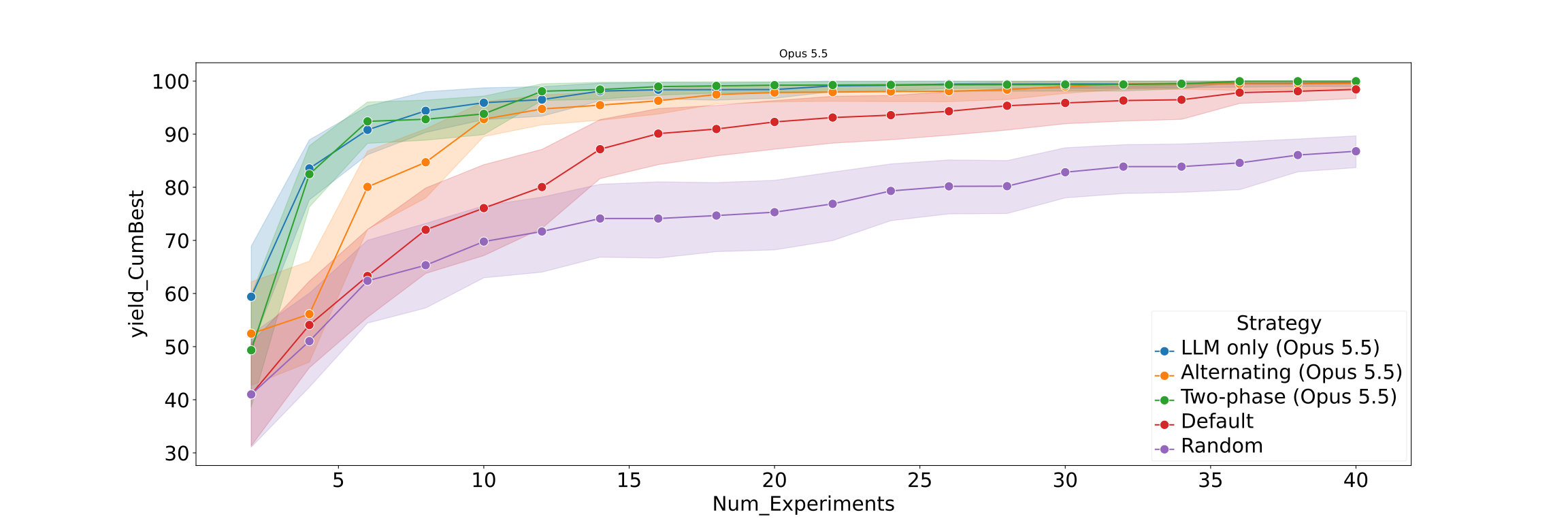
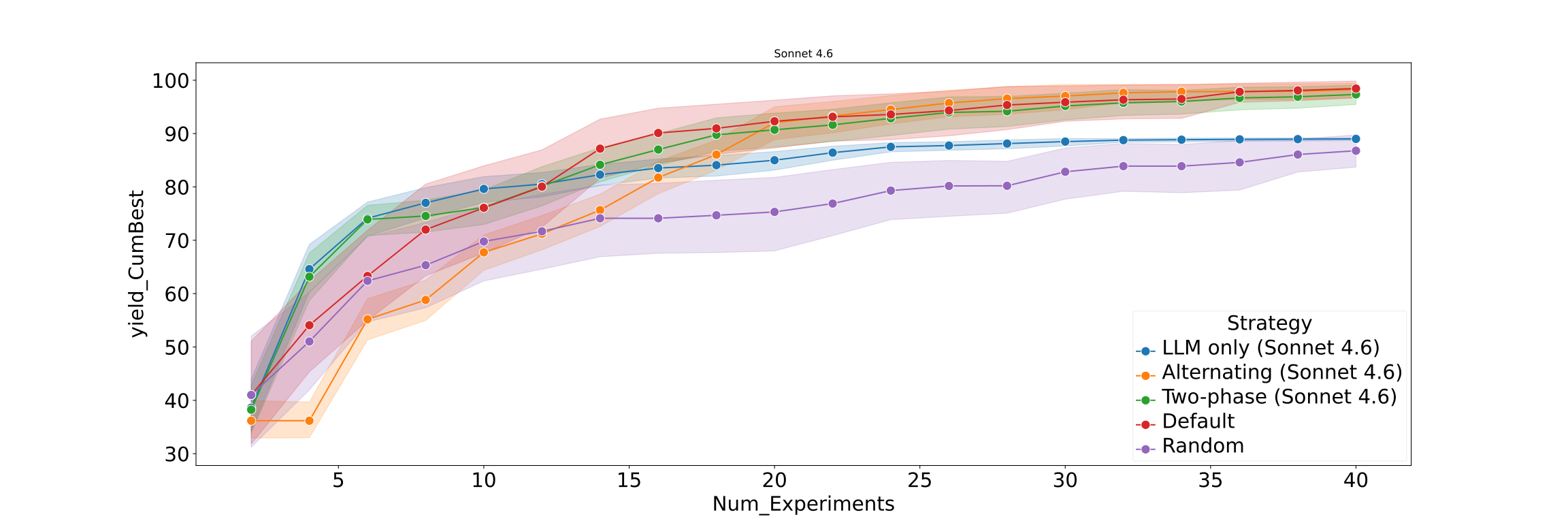
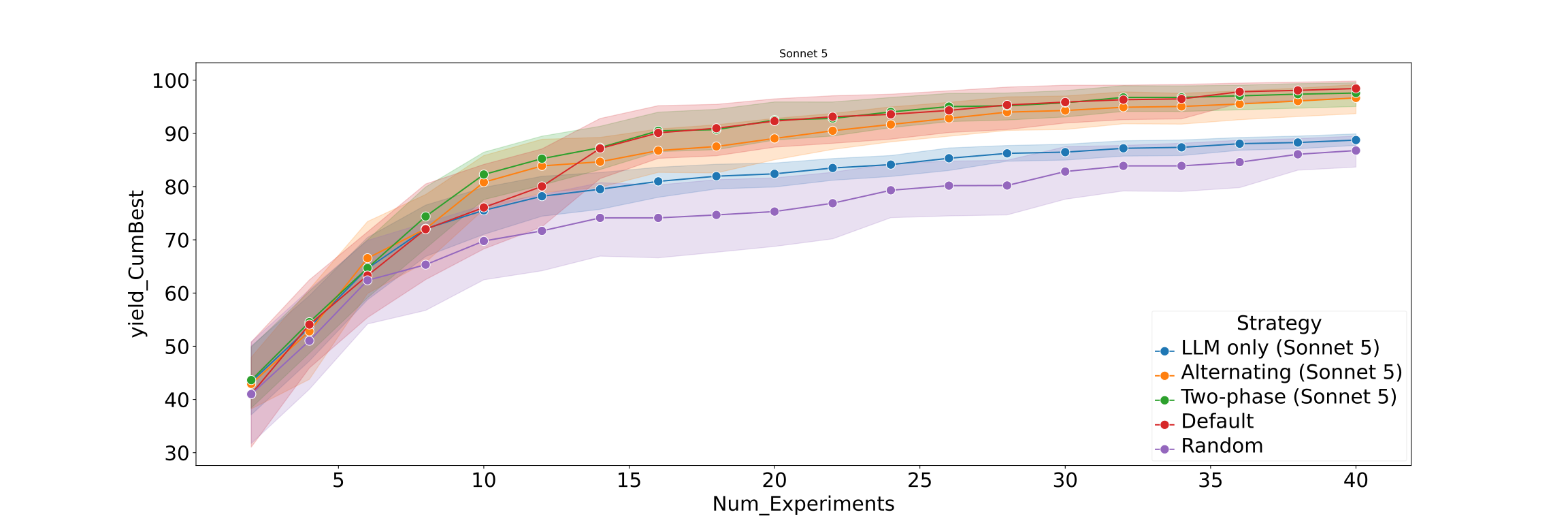
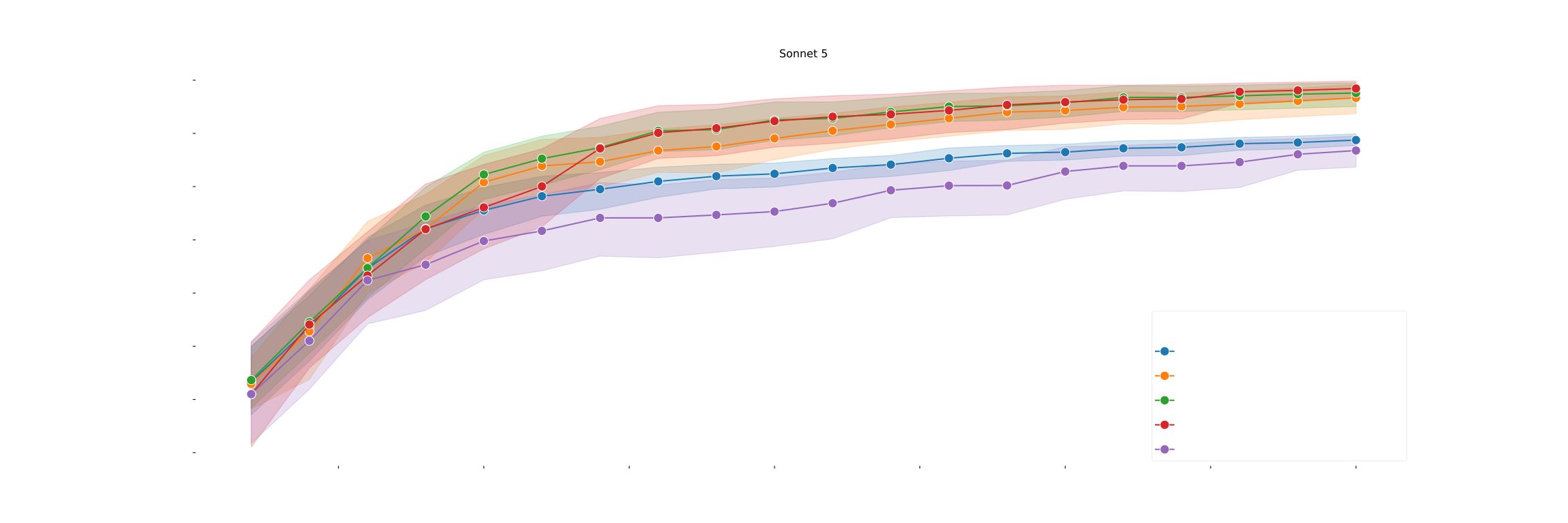
The results above come from a mocked LLM and do not reflect real optimization performance. The plots below were generated by running the same comparison — LLM only, Two-phase, Alternating, Default, and Random — with actual language models on the full 1728-configuration search space over 20 DOE iterations and 35 Monte Carlo runs. Each plot shows all strategies for one model.
Claude Sonnet 4.6
Claude Sonnet 5
Claude Opus 5.5